
Tristan Ishtar
VP of Sales
The choice between peeled and unpeeled eucalyptus poles shapes a project’s visual character before anyone notices the hardware, the roofline, or the surrounding materials. It affects the level of rusticity, how consistent the finished installation feels, and whether the material fits the setting being created — and it matters more than many teams expect.
Start With the Look You Are Trying to Create
The fastest way to make the wrong choice is to ask which option is “better” without asking what the design is trying to do. Some projects need a cleaner, more refined natural look. Others need the poles to feel rougher, more organic, or more obviously rustic. A resort entry, a zoo feature, a themed restaurant patio, and a pergola at a hospitality property may all use eucalyptus, but they do not all need the same finish character.
Before specifying, it helps to ask:
- Is the project aiming for polished rustic or rough rustic?
- Will guests see the poles up close or mostly from a distance?
- Is the eucalyptus a major visual feature or a supporting one?
- Does the surrounding architecture lean refined, rugged, or somewhere in between?
An Important Note on Bark and Import Regulations
Before getting into finish character, there is a practical reality that shapes this decision for every commercial project: the EPA and USDA do not allow eucalyptus poles to be imported into the United States with bark intact. All poles must be debarked before entering the country.
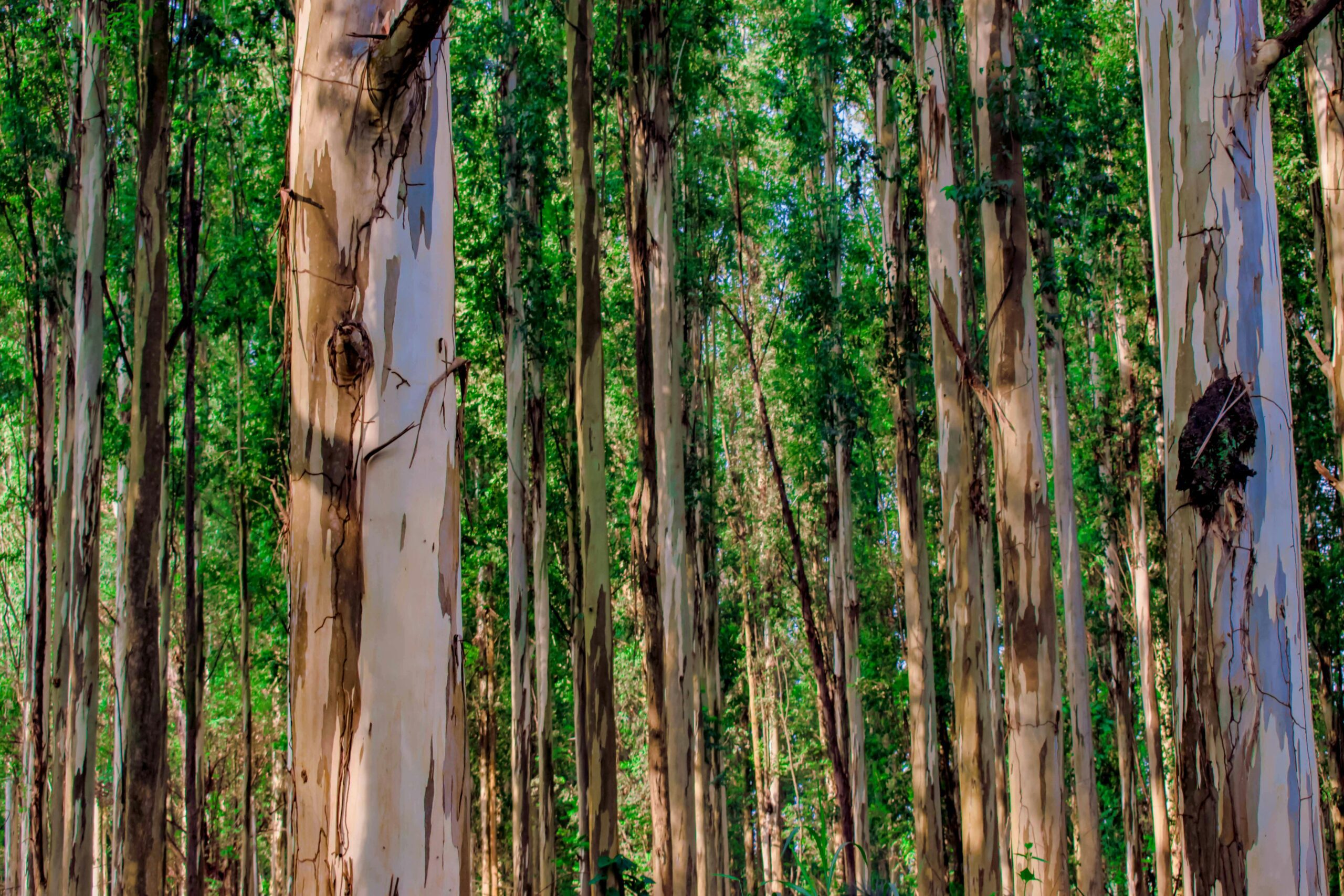
That means truly “unpeeled” eucalyptus — poles with full bark still attached — is not an option for imported material. What the industry refers to as unpeeled poles are poles that have been debarked but retain more of the natural surface texture, roughness, and character beneath the bark, rather than being smoothed down further. Peeled poles go a step further, with more of the outer surface removed for a cleaner, more uniform appearance.
This distinction matters when specifying. If a designer or owner is picturing bark-on poles from an inspiration image, that expectation needs to be corrected early.
What Peeled Eucalyptus Poles Usually Communicate
Peeled eucalyptus poles tend to feel cleaner and more controlled visually. They still read as natural wood but often fit better when the design wants a rustic material without too much visual noise.
That makes peeled poles a strong fit for:
- Hospitality spaces where guests will see the poles up close
- Restaurant patios and dining areas
- Trellises and pergolas with a more finished appearance
- Projects where several poles are placed in repeated visible patterns
- Spaces blending tropical character with a more polished design language
This is especially useful when eucalyptus is paired with cleaner materials such as finished decking, cable rail, metal connectors, stone, or more contemporary lighting and furniture. In those settings, a peeled pole helps the project feel intentional rather than raw.
What Unpeeled Eucalyptus Poles Usually Communicate
Unpeeled eucalyptus poles — again, debarked per import requirements but with more natural surface texture retained — generally push the design in a rougher, more organic direction. They can feel more rugged, more natural, and more visibly tied to an outdoor or themed setting.
That kind of look tends to work well for:
- Zoo environments and wildlife habitats
- Heavily themed entertainment spaces
- Rustic fencing and perimeter treatments
- Immersive outdoor environments
- Projects where the goal is a less processed, more natural appearance
The tradeoff is that the look is usually less uniform. That can be a benefit when natural irregularity is the whole point. It can be a drawback when the design depends on a more consistent and controlled rhythm.
Peeled vs Unpeeled in Real Design Scenarios
Scenario 1: Resort Shade Structure
A resort wants eucalyptus for a poolside pergola and dining area. Guests will be close to the poles, the furniture is refined, and the project needs a tropical feel without looking rough. Peeled poles are likely the better fit — they keep the natural character while supporting a cleaner presentation. This is a common approach in resort and theme park construction where visual consistency across a large installation matters.
Scenario 2: Zoo Habitat or Themed Queue
A zoo or themed environment wants a more immersive, rugged visual language. The poles are part of the storytelling, and a little irregularity helps. Unpeeled poles tend to make more sense here because the rougher surface supports the experience.
Scenario 3: Rustic Fencing
If the goal is a truly rustic perimeter, unpeeled poles may reinforce that better. If the fence is meant to look more finished and compatible with refined architecture nearby, peeled is likely the stronger choice. amaZulu’s rustic eucalyptus fencing offers a useful reference point for what that look can achieve.
What Designers and Contractors Should Coordinate Early
The peeled vs unpeeled choice can affect more than aesthetics. It can also shape expectations during submittals, samples, and installation review.
Visual expectations. Do not assume everyone means the same thing when they say “rustic.” One person may picture a smooth natural pole. Another may picture something much rougher. Clarifying the import reality around bark early also prevents misaligned inspiration images from driving the brief.
Sample review. A physical sample tells the team more than a description ever will. This is especially important given that the surface character of debarked-but-unpeeled poles can vary, and seeing the material in person removes ambiguity.
Relationship to adjacent materials. A rougher pole may look great beside natural fencing, rope, or heavily themed surfaces. A cleaner peeled pole may sit better beside finished pavers, steel details, or hospitality-grade furnishings.
Repetition and spacing. If the project uses many visible poles in a row, the level of surface consistency matters more. Reviewing eucalyptus pole specifications for commercial projects can help teams set the right expectations before drawings are finalized.
A Common Mistake: Choosing Based on the Word “Authentic”
Teams sometimes assume unpeeled automatically means more authentic and therefore better. That is not always true. Authenticity is not just about how rough the pole looks — it is about whether the material choice fits the environment being built.
A peeled pole may actually feel more right in a resort, restaurant, or commercial setting where the project needs natural character but also visual control. An unpeeled pole may feel more right where the setting is supposed to look less refined. The wrong move is picking one because it sounds more natural without checking whether it actually serves the project.
Make the Decision Early and Test It With Samples
A practical way to make this call is to walk through a short decision filter. If the project needs a cleaner, more finished natural look, start with peeled. If the project needs a rougher, more rugged look, start with unpeeled. Then review the choice against three things: sample appearance, adjacent materials, and viewing distance. That usually confirms the right direction quickly.
If there is still uncertainty, it is better to settle it with samples early than to let it become a debate during submittals or after installation starts.
Contact amaZulu to request samples of both finishes and get guidance on which option is the right fit for your project.
Tristan Ishtar
VP of Sales
With over 11 years at amaZulu, Tristan brings deep expertise in tropical building materials and a customer-focused approach. He serves as a trusted consultant for architects and designers, providing expert guidance without high-pressure sales.