

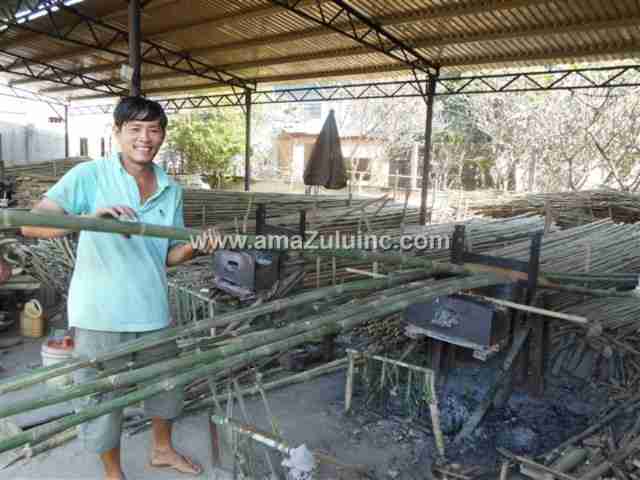
When amaZulu founder Claire Evans walked into a exotic materials factory in Vietnam, it wasn’t the bamboo or thatch that caught her attention – it was something entirely unexpected.
Claire – who hails from South Africa and lives in the Orlando, Florida area – was considering several suppliers for an urgent job on behalf of a major theme park developer. As she always does when choosing between suppliers, she flew thousands of miles to see how they operate.
“Usually when I walk into a factory, everyone’s just sitting on the floor doing their thing,” she said. “The factory owner never, ever spoke to anyone while standing up and looking down at them. If he spoke to them, he knelt down and he met them eye to eye.”
That seemingly small moment – a factory owner showing a little bit of respect to his workers – provided a glimpse into this supplier’s character. But what Claire learned next sealed the deal for the next two decades of partnership.
“He also told me that he had a lot of the ladies in the factory who had children, and he had a floor above the factory where somebody was employed to look after their children so they could have them nearby and taken care of,” she said.
That factory owner in Vietnam is still amaZulu’s supplier today – not because his prices were the lowest, but because of how he treated his people. It’s a perfect example of why, after over 22 years of sourcing natural thatch, bamboo, and eucalyptus products from around the globe, Claire has never wavered from one fundamental principle: you have to see where your materials come from.
Learn more about our complete range of natural and synthetic bamboo, eucalyptus, and thatch materials here.
Why Every Factory Gets a Personal Visit
In an age of digital sourcing and online marketplaces, Claire’s approach might seem old-fashioned. But for her, it’s non-negotiable.
“Any product that we source from anywhere in the world, I personally fly to that factory and make sure that the product is good, they’re ethical, and I tell them about our standards,” Claire explains. “We go through all that, and then I’m comfortable with doing business with them.”
This hands-on approach isn’t just about quality control – it’s about building relationships with partners who share amaZulu’s values. Because when you’re sourcing natural materials from developing countries, the story behind the product is just as important as the product itself.
“I will never buy from a factory I haven’t personally seen,” Claire says. It’s a policy that has served amaZulu well, preventing costly mistakes and ensuring that every shipment meets the exacting standards of commercial clients.
When a Visit Raises Red Flags
Not every sourcing trip ends with a success story. Sometimes, the most valuable visits are the ones that prevent disasters. When a major theme park developer asked Claire to develop synthetic thatch made from recycled plastic, she thought she had found the perfect partner in China. The reality was far different.
“Before I even pulled into the gate, I could smell it, and what we assumed was recycled plastic was babies’ diapers and old milk bottles,” she said. “They had melted this all down.”
What Claire discovered was a factory producing plastic planters for major retailers using dangerous and unethical practices.
“The fumes that were coming off there were very concerning,” she said. “We shut that project down straight away.”
This experience reinforced why factory visits are essential: “That’s why I go to the factory – because what you hear and what you see is very different to what you see.”

Quality Control Beyond Certificates
In the world of international sourcing, certificates and test results are easy to obtain – but they don’t always tell the whole story. Claire has learned to trust only testing done to U.S. standards, by U.S. facilities.
“A lot of the foreign factories will send us a certificate and say, ‘Look, we’ve been tested. It passes,’” she said. “And I’ll say to them, ‘All right, I’ll have it tested in the U.S., and if it passes, then you can be my vendor.'”
When it comes to treatments and certifications, there’s no room for compromise: “It has got to be up to U.S. standards.”
This rigorous approach to testing has been shaped by working with the most demanding clients in the industry. amaZulu works with some of the biggest theme park brands in the world, and therefore must achieve testing standards that go far beyond what most suppliers encounter in order to serve those clients.
Sustainability as a Starting Point
Environmental responsibility isn’t an afterthought in amaZulu’s sourcing process – it’s where every decision begins.
“We try to go green first – it’s always our first option, even if it is a little bit more expensive,” Claire notes.
This commitment to sustainability sometimes requires difficult compromises. When developing synthetic products, for example, Claire discovered that recycled plastics don’t hold color as well under UV exposure. The solution? “We’ve now gone for new plastic, but make sure that it’s all recyclable,” she said. “So if someone has a problem and they want to take off a roof and replace it, we know that that can be all recycled and made into something else.”
Real-World Results: A Case Study
The difference between proper sourcing and cutting corners becomes crystal clear when things go wrong. Claire recalls a project where a major theme park developer had initially chosen a cheaper supplier from Colombia for eucalyptus poles.
“They had installed it, and about six months later, they called me in and said, ‘Can you just come have a look at this? We’re not sure why this is rotting,’” she said.
The problem was immediately apparent after a thorough examination of the poles themselves.
“We make sure our factory goes at least 25% of the penetration into a eucalyptus pole. And you can see it, it’s a dark ring around the eucalyptus pole,” she said. “I looked at these poles, and it was not even an eighth of an inch.”
The supplier had cut corners on the treatment process, dipping poles quickly to save on chemicals rather than ensuring proper penetration. The result was rotting poles and a costly replacement project.
“We cut it all down and they bought the whole lot again from us, and we’ve never lost them as a customer,” she said.

The amaZulu Difference
In an industry where it’s increasingly easy to source materials sight unseen through online platforms, amaZulu’s commitment to personal relationships and firsthand quality control sets us apart. It’s an approach that ensures when designers and architects specify materials for a theme park, resort, or commercial project, they’re not just getting a product – they’re getting the assurance that comes from knowing exactly where that product came from and how it was made.
Whether it’s natural thatch for an authentic Polynesian village or synthetic bamboo that needs to withstand hurricane-force winds, every amaZulu product carries with it the story of its origin—and the guarantee that it was sourced with integrity, quality, and sustainability in mind.
When commercial designers and architects choose amaZulu, they’re choosing a partner who literally goes the extra mile. Because in this industry, the difference between good enough and exceptional isn’t found in a catalog – it’s found in the villages, forests, and factories where our materials begin their journey to your project.